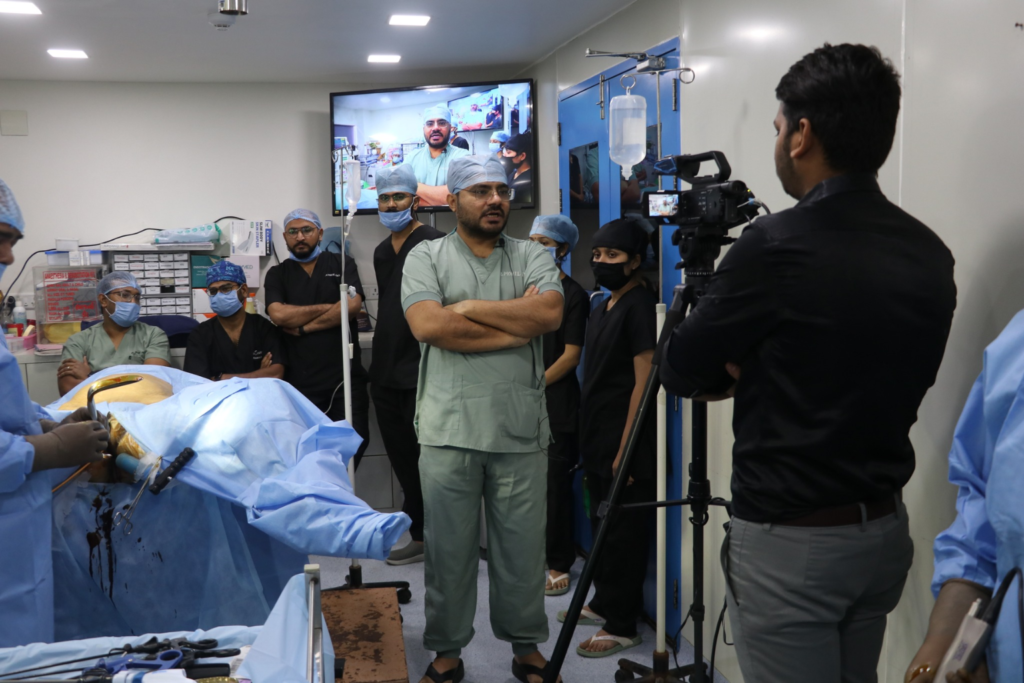
Short answer: no. For a large number of women with a prolapsed uterus, the uterus does not have to be removed. Hysterectomy remains one valid option among several, but it is not the automatic answer it is often presented to be, and in some situations it is not even the operation that fixes the problem.
I say this as a laparoscopic and gynae-endoscopic surgeon who sees the other side of this decision every week: women in their forties and fifties who were told, sometimes within five minutes of an examination, that the uterus “has come down and must be taken out.” Many of them were never offered a pessary. Most were never sent for pelvic floor physiotherapy. Almost none were told that uterus-preserving repair operations exist and are supported by good randomised evidence.
This article walks through what uterine prolapse actually is, every treatment option on the table, what the research shows about each, and the specific situations where hysterectomy really is the right call.
Key takeaways
- Uterine prolapse is a failure of pelvic support, not a disease of the uterus itself. Removing the uterus does not automatically restore support.
- Nearly 8 percent of hysterectomies reported by Indian women list prolapse as a reason, based on National Family Health Survey data, yet conservative options are rarely tried first.
- Pelvic floor muscle training and a well-fitted vaginal pessary help many women with early or moderate prolapse, and both are reversible.
- In a Dutch randomised trial followed for five years, uterus-preserving sacrospinous hysteropexy produced fewer apical recurrences than vaginal hysterectomy with uterosacral suspension.
- Hysterectomy is still the correct operation in specific circumstances, including suspected malignancy, abnormal bleeding that has failed treatment, and large fibroids or adenomyosis alongside the prolapse.
What Uterine Prolapse Actually Is
The uterus is held in place by a suspension system: the uterosacral and cardinal ligaments above, the levator ani muscles and endopelvic fascia below. Childbirth, chronic straining, heavy manual labour, chronic cough, obesity and the collagen changes of menopause weaken that system. When it gives way, the uterus and cervix descend along the vaginal canal.
The important point, and the one that changes the whole treatment conversation, is this: the uterus is not the faulty part. It is the passenger, not the problem. The ligaments and muscles holding it are the problem. That distinction is why a hysterectomy performed without a proper apical suspension can leave a woman with the same bulge sensation a few years later, this time as vaginal vault prolapse.
How prolapse is graded
Gynaecologists use the POP-Q system, but the practical version is simple:
- Stage 1: descent is present but the cervix stays well inside the vagina. Usually no symptoms.
- Stage 2: the cervix reaches close to the vaginal opening. Dragging sensation, a feeling of something coming down by evening.
- Stage 3: the cervix protrudes outside the vaginal opening. Visible bulge, difficulty passing urine or stool, discomfort walking.
- Stage 4: complete procidentia, the uterus is fully outside. Ulceration and infection can develop.
Stage matters, but it is not the only thing that decides treatment. Two women with identical stage 3 prolapse can need completely different plans depending on age, symptoms, bleeding pattern, fertility wishes, fitness for anaesthesia and what actually bothers them day to day.
Why Hysterectomy Became the Default Answer in India
Hysterectomy for prolapse is a habit as much as a clinical decision. It is taught early in training, it is technically familiar to every gynaecologist, and it produces an immediate, visible result on the operating table. Conservative care, by contrast, requires follow-up visits, physiotherapy referrals and pessary reviews, which are harder to organise and rarely reimbursed well.
The population data reflect this. National Family Health Survey analyses put hysterectomy prevalence at around 3.3 percent of Indian women aged 15 to 49, with roughly 7 to 8 percent of those procedures reported by women as being done for uterine prolapse. Most take place in private hospitals, and the average age at surgery in some Indian studies sits in the mid-thirties. Public health researchers have repeatedly flagged the volume of avoidable hysterectomies and recommended that alternative treatments be offered first.
None of this means hysterectomy is wrong. It means the decision deserves more than five minutes.
The Full Menu of Treatment Options
Think of prolapse treatment as a ladder. Most women should start on the lowest rung that is likely to control their symptoms, and move up only if it does not.
1. Watchful waiting and lifestyle correction
Appropriate for stage 1 and mild stage 2 prolapse that is not causing bother. Prolapse is not dangerous in itself, and mild descent does not inevitably progress. What helps:
- Weight reduction, which lowers chronic intra-abdominal pressure
- Treating chronic constipation so straining stops
- Treating chronic cough, including smoking cessation and asthma control
- Avoiding repetitive heavy lifting where possible, or learning to brace correctly
- Vaginal oestrogen after menopause, which improves tissue quality
2. Pelvic floor muscle training
Not the vague “do your Kegels” advice, but a supervised programme taught by a pelvic floor physiotherapist, sustained for at least 16 weeks. National Institute for Health and Care Excellence guidance in the UK recommends offering a supervised programme of this length to women with symptomatic stage 1 or stage 2 prolapse before considering surgery.
Realistic expectation: pelvic floor training improves symptoms and can reduce the sensation of bulge. It does not lift a stage 3 uterus back into position. It is most useful early, and it is worth doing even before surgery, because a stronger pelvic floor supports any repair that follows.
3. Vaginal pessary
A silicone device fitted into the vagina to support the descended uterus. Ring, ring-with-support, Gellhorn and cube designs cover most anatomies. Fitting is an outpatient procedure, and once a woman is taught to remove and clean it herself, follow-up is straightforward.
A pessary is the right first choice for women who are unfit for anaesthesia, who have not completed their family, who want to delay surgery, or who simply want to know whether relieving the bulge relieves their symptoms before committing to an operation.
Be aware of what the evidence shows, because honest counselling matters here. In a large Dutch randomised trial comparing pessary therapy with surgery for moderate to severe prolapse, pessary treatment did not meet the criteria for non-inferiority to surgery at two years, and roughly 54 percent of women assigned to a pessary eventually crossed over to surgery. Healthcare and societal costs were significantly lower in the pessary group. In plain terms: a pessary is a genuine and inexpensive option, it works well for a substantial minority, and about half of women will still choose surgery later. That is useful information, not a reason to skip the attempt.
Not sure which rung of the ladder you are on?
A proper prolapse assessment takes one consultation: a POP-Q examination, a discussion of what actually bothers you, and a written plan that lists every option, not just the surgical one.
Dr Mohil Patel — MBBS, DGO, FMAS (Mumbai)
Advanced Laparoscopic & Gynae-Endoscopic Surgeon
Ankur Maternity Home & Clinic
423 Avani Icon, Haridarshan Cross Road, opp. Shalby Hospital, Nava Naroda, Ahmedabad, Gujarat 382330
Phone: 099791 14848
4. Uterus-sparing (uterine-preserving) surgery
This is the category most women are never told about. The principle is to re-suspend the uterus to a strong anatomical anchor while leaving the organ in place. The main techniques:
- Sacrospinous hysteropexy. The cervix is fixed to the sacrospinous ligament through a vaginal approach. No abdominal incision, no mesh required in the suture version.
- Manchester (Fothergill) repair. The elongated cervix is amputated and the cardinal and uterosacral ligaments are plicated to shorten and re-suspend the support. Long-established, and it has performed extremely well in recent trials.
- Laparoscopic sacrohysteropexy. A mesh strip suspends the cervix to the anterior longitudinal ligament of the sacrum, done keyhole. Strong apical support, quick recovery, and my preferred option in younger women with severe apical descent.
- Laparoscopic pectopexy. Suspension to the pectineal ligaments instead of the sacral promontory. Useful in obese women and where the presacral space is risky.
- Shirodkar sling and modified abdominal slings. Still relevant in selected Indian practice, particularly for younger women.
How well do uterus-sparing repairs actually work?
This is where the evidence has shifted meaningfully in the last decade.
The Dutch SAVE-U trial randomised women with stage 2 or higher uterine prolapse to sacrospinous hysteropexy or vaginal hysterectomy with uterosacral ligament suspension, then followed them annually for five years. At five years, apical surgical failure with bothersome bulge symptoms or repeat surgery occurred in 1 percent of the hysteropexy group compared with 7.8 percent after hysterectomy, and composite success favoured the uterus-sparing operation at 87 percent versus 76 percent.
A second Dutch randomised trial, SAM, compared two uterus-sparing operations against each other in 434 women having their first prolapse surgery. At two years, the Manchester procedure achieved success in 87.3 percent compared with 77.0 percent for sacrospinous hysteropexy, and sacrospinous hysteropexy did not meet the pre-set non-inferiority margin. The practical lesson is that “uterus-sparing” is not one operation, and the choice between them matters.
Uterus-preserving procedures also involve shorter operating time and less blood loss than operations that include hysterectomy. In a US trial network, researchers noted that despite this, hysteropexy accounted for only about 5 percent of uterovaginal prolapse surgeries in a large inpatient database, with hysterectomy performed roughly eight times more often.
When Hysterectomy Genuinely Is the Right Operation
I want to be equally clear in the other direction. Preserving the uterus is not a virtue in itself, and refusing a hysterectomy that is clinically indicated is its own kind of harm. Removal is the correct decision when:
- There is suspicion of malignancy in the cervix, endometrium or ovaries, or an abnormal Pap smear or endometrial biopsy that has not been resolved.
- Postmenopausal bleeding or persistent abnormal uterine bleeding that has not responded to appropriate treatment.
- Significant fibroids or adenomyosis are present alongside the prolapse and are themselves causing symptoms.
- Complete procidentia with a chronically ulcerated, hypertrophied cervix where the tissue itself is no longer usable for suspension.
- Recurrence after a previous uterus-sparing repair, where the anatomy no longer supports another attempt.
- The woman herself, fully informed of the alternatives, prefers it. That is a legitimate reason and it should be respected.
One caveat that applies to every hysterectomy done for prolapse: the apex must be suspended at the same operation. Removing the uterus without fixing the vaginal vault to the uterosacral or sacrospinous ligaments treats the passenger and leaves the broken suspension in place. Post-hysterectomy vault prolapse is a real and avoidable complication.
Comparing Your Options at a Glance
| Option | Best suited to | Reversible? | Typical recovery |
|---|---|---|---|
| Lifestyle and pelvic floor training | Stage 1 to mild stage 2, symptoms tolerable | Yes | No downtime, 16 weeks to judge |
| Vaginal pessary | Any stage; unfit for surgery, family not complete, wants to defer | Yes | Same day, review in 2 to 6 weeks |
| Manchester repair | Cervical elongation, descent not past the hymen, uterus to be preserved | No | 2 to 4 weeks |
| Sacrospinous hysteropexy | Apical descent, vaginal route preferred, uterus to be preserved | No | 2 to 4 weeks |
| Laparoscopic sacrohysteropexy | Younger women, severe apical descent, strong support needed | No | 1 to 3 weeks |
| Hysterectomy with apical suspension | Malignancy risk, abnormal bleeding, fibroids or adenomyosis, patient preference | No | 3 to 6 weeks |
Five Questions to Ask Before You Agree to Surgery
If you have been advised a hysterectomy for prolapse, take these questions to the consultation. A surgeon who is comfortable with the full range of options will welcome them.
- What stage is my prolapse, and which compartment is worst? Anterior, apical and posterior compartments need different repairs.
- Is there any reason my uterus itself needs to come out? Ask specifically about bleeding, fibroids, adenomyosis and cancer screening results.
- Have we tried a pessary or pelvic floor physiotherapy? If not, why is that step being skipped?
- If we operate, how will the apex be supported? Any prolapse operation without an apical suspension plan is incomplete.
- Do you perform uterus-sparing repairs, and how many? If the answer is no, ask for a referral rather than accepting the operation your surgeon happens to do.
Get a second opinion before the uterus goes
A hysterectomy cannot be undone. A consultation can. If you have been advised uterus removal for prolapse and want the alternatives assessed properly, book a review at Ankur Maternity Home & Clinic, Nava Naroda.
Dr Mohil Patel — MBBS, DGO, FMAS (Mumbai)
Advanced Laparoscopic & Gynae-Endoscopic Surgeon
423 Avani Icon, Haridarshan Cross Road, opp. Shalby Hospital, Nava Naroda, Ahmedabad, Gujarat 382330
Call 099791 14848 to book a prolapse assessment.
Frequently Asked Questions
Can uterine prolapse be cured without surgery?
Mild prolapse can be managed effectively without surgery using supervised pelvic floor muscle training, weight and constipation control, vaginal oestrogen after menopause, and a fitted pessary. These approaches control symptoms rather than restore the anatomy permanently, so “managed” is a more accurate word than “cured.” For stage 3 and stage 4 prolapse, non-surgical treatment is usually a holding measure rather than a definitive solution.
Will I still get periods after uterus-sparing prolapse surgery?
Yes. Sacrospinous hysteropexy, laparoscopic sacrohysteropexy and pectopexy leave the uterus and cervix intact, so menstruation continues normally. The Manchester repair amputates part of the cervix, so periods continue but the cervical canal is shortened, which is relevant if you are planning a pregnancy.
Can I get pregnant after prolapse surgery?
Pregnancy is possible after uterus-preserving repair, and preserving fertility is one of the main reasons to choose it. That said, pregnancy and delivery place stress on any repair, and delivery is usually planned by caesarean section after sacrohysteropexy. If you have not completed your family, say so at the first consultation, because it changes which operation is appropriate.
Is a pessary safe to use long term?
Yes, with regular review. The main issues are vaginal discharge, irritation and, if a pessary is neglected for years, erosion. Women who learn to remove, clean and reinsert the device themselves manage very well. Vaginal oestrogen cream is often prescribed alongside it in postmenopausal women to keep the tissue healthy.
Does hysterectomy fix prolapse permanently?
Not by itself. Removing the uterus without suspending the vaginal vault leaves the underlying support defect untreated, and vault prolapse can follow years later. When a hysterectomy is performed for prolapse, it should always be combined with a proper apical suspension such as uterosacral ligament suspension or sacrospinous fixation.
How long is recovery after laparoscopic sacrohysteropexy?
Most women go home within one to two days and return to desk work in one to two weeks. Heavy lifting, gym work and intercourse are typically restricted for six weeks to protect the repair. Recovery is generally faster than after an open or vaginal hysterectomy, which is one of the practical advantages of the keyhole approach.
I am 32 and already have a stage 2 prolapse. Is surgery my only option?
No, and at 32 surgery would rarely be the first step. Structured pelvic floor physiotherapy, correction of any chronic straining or cough, and a pessary trial come first. If surgery becomes necessary later, a uterus-preserving repair would almost always be the plan rather than hysterectomy.
The Bottom Line
Uterine prolapse is a support problem, and support problems can be treated in more than one way. Pelvic floor therapy, a pessary, a Manchester repair, a sacrospinous hysteropexy and a laparoscopic sacrohysteropexy are all legitimate answers, and randomised evidence over five years shows that keeping the uterus does not mean accepting a worse outcome.
Hysterectomy still has a clear place, and when it is indicated it should be done well and with the apex properly suspended. What it should not be is the only option on the table before anyone has examined whether you need it.
If you are living with a dragging sensation, a visible bulge, urinary leakage or difficulty passing stool, and someone has already told you the uterus must come out, get the full picture first. The operation will still be available next month. The uterus will not be, once it is gone.
About the author. Dr Mohil Patel (MBBS, DGO, FMAS – Mumbai) is an Advanced Laparoscopic and Gynae-Endoscopic Surgeon practising at Ankur Maternity Home & Clinic, Nava Naroda, Ahmedabad. He is Programme Director of the DRISHTI Fellowship in advanced gynaecological endoscopy and a Managing Committee Member of the Indian Association of Gynaecological Endoscopists.
References
- Schulten SFM, Detollenaere RJ, Stekelenburg J, et al. Sacrospinous hysteropexy versus vaginal hysterectomy with uterosacral ligament suspension in women with uterine prolapse stage 2 or higher: observational follow-up of a multicentre randomised trial. BMJ, 2019. PubMed
- Enklaar RA, Schulten SFM, van Eijndhoven HWF, et al. Manchester procedure vs sacrospinous hysteropexy for treatment of uterine descent: a randomized clinical trial. JAMA, 2023;330(7):626-635. PubMed
- van der Vaart LR, Vollebregt A, Milani AL, et al. Effect of pessary vs surgery on patient-reported improvement in patients with symptomatic pelvic organ prolapse: a randomized clinical trial. JAMA, 2022; and Ben AJ, van der Vaart LR, Bosmans JE, et al. Cost-effectiveness of pessary therapy versus surgery for symptomatic pelvic organ prolapse. BMJ Open, 2024. PMC
- Nager CW, Visco AG, Richter HE, et al. Effect of sacrospinous hysteropexy with graft vs vaginal hysterectomy with uterosacral ligament suspension on treatment failure in women with uterovaginal prolapse: 5-year results of a randomized clinical trial. American Journal of Obstetrics and Gynecology, 2021. PMC
- Singh A, Govil D. Hysterectomy in India: spatial and multilevel analysis. Women’s Health (SAGE), 2021. SAGE Journals
- Prusty RK, Choithani C, Gupta SD. Prevalence, socio-demographic determinants and self-reported reasons for hysterectomy in India. BMC Women’s Health, 2022. PMC
- National Institute for Health and Care Excellence. Urinary incontinence and pelvic organ prolapse in women: management (NG123).
Medical disclaimer: This article is for general education and does not replace an individual consultation. Treatment for uterine prolapse depends on your examination findings, symptoms, age, reproductive plans and general health. Please consult a qualified gynaecologist before making any treatment decision.