
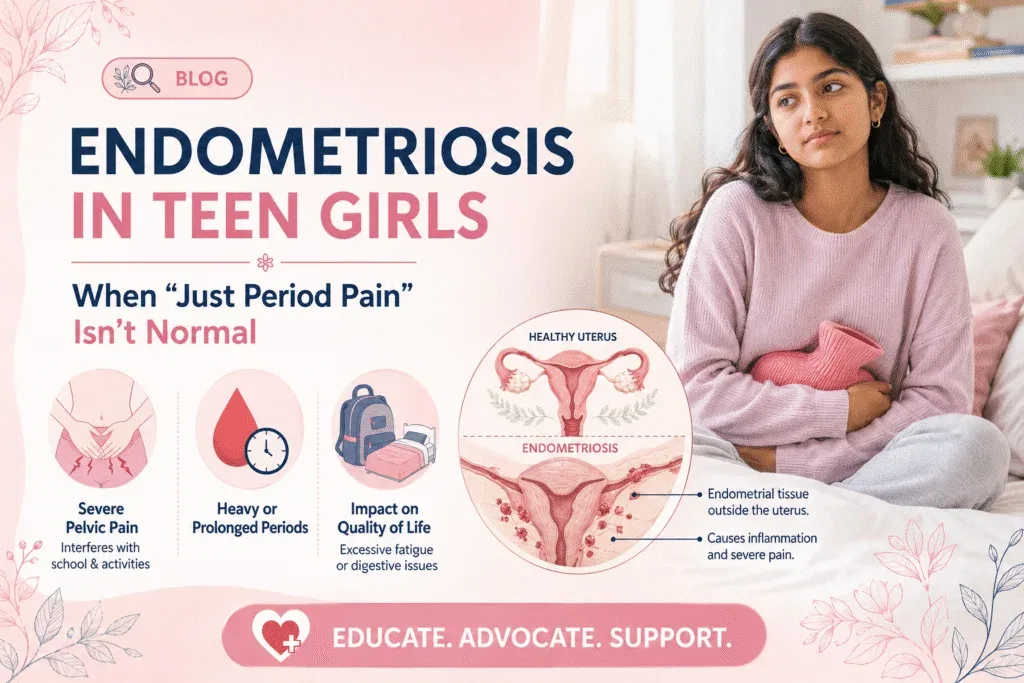
For too many young girls in India, debilitating period pain is dismissed as a rite of passage. “She’ll grow out of it.” “Every woman goes through this.” “Take a hot water bag and rest.” These words — said with love, often by mothers and grandmothers — can hide a condition that quietly steals years from a girl’s adolescence: endometriosis.
In my surgical practice, I have operated on women in their thirties whose endometriosis almost certainly began at thirteen or fourteen. By the time they reach me, they have endured a decade of pain, fertility setbacks, and missed opportunities — all because no one took their teenage cramps seriously. We can do better. And it starts with awareness.
What Is Endometriosis?
Endometriosis is a chronic, inflammatory, oestrogen-dependent condition in which tissue similar to the lining of the uterus grows outside the uterine cavity — on the ovaries, fallopian tubes, pelvic peritoneum, bowel, or bladder. With every menstrual cycle, this misplaced tissue bleeds, scars, and inflames the surrounding organs.
Once thought to be a disease of “career women in their thirties,” we now know endometriosis can begin almost as soon as menstruation does. International data suggest that up to 70% of adolescents with chronic pelvic pain unresponsive to standard treatment have endometriosis confirmed at laparoscopy.
Why Is It Missed in Teenagers?
In my experience, three reasons stand out:
Cultural normalisation of period pain. In many Indian households, severe dysmenorrhoea is treated as ordinary. Girls are told to endure.
Atypical presentation in adolescents. Teenage endometriosis often shows up as cyclical and acyclical pain, gastrointestinal upset, or unexplained fatigue — not the textbook “deep pelvic pain with intercourse” seen in adults.
Diagnostic hesitation. Many clinicians are reluctant to investigate a young girl, fearing they will “label” her. The cost is an average diagnostic delay of 7 to 10 years.
Those lost years matter. Endometriosis is progressive. Early-stage disease left untreated can advance to deep infiltrating endometriosis, ovarian endometriomas (chocolate cysts), and tubal damage — directly affecting future fertility.
Red Flags Every Parent Should Recognise
Bring your daughter to a gynaecologist if she experiences:
- Period pain that keeps her home from school or needs more than basic painkillers
- Pain that worsens cycle after cycle rather than easing with age
- Heavy or prolonged bleeding (more than 7 days, or soaking through protection hourly)
- Cyclical bowel or bladder symptoms — diarrhoea, painful defecation, or urinary urgency that tracks with her period
- Pelvic pain between periods
- Persistent fatigue, nausea, or unexplained weight changes around menstruation
- A family history of endometriosis — risk is 7–10 times higher if a first-degree relative is affected
If your daughter is missing classes, board exams, or her favourite sport because of her cycle, that is not normal. That is a medical signal.
How We Diagnose It
Diagnosis begins with a careful history — far more revealing than any scan in adolescents. A transabdominal or, where appropriate, transrectal ultrasound by an experienced operator can identify endometriomas and deep nodules. MRI helps in selected cases.
However, the gold standard remains diagnostic laparoscopy — a keyhole procedure in which I directly visualise, biopsy, and treat endometriotic lesions in the same sitting. In adolescents, lesions often look different from adult disease — clear vesicles, red flame-shaped patches — which is why an experienced eye matters.
Treatment: A Stepwise, Fertility-Preserving Approach
There is no single cure for endometriosis, but there is excellent control. My approach with adolescents is graded and conservative:
First-line medical therapy: NSAIDs and combined oral contraceptives or progestin-only pills to suppress cyclical bleeding and inflammation.
Second-line: Dienogest or, in selected cases, GnRH analogues with add-back therapy.
Surgical management is reserved for girls with persistent pain despite medical therapy, ovarian endometriomas, or suspected deep disease. With advanced laparoscopic techniques, we excise lesions precisely while preserving every millimetre of ovarian reserve — critical for her future fertility.
Surgery in a teenager should never be aggressive or cosmetic. It should be diagnostic, therapeutic, and ovary-sparing — performed by a surgeon who understands that her reproductive future is the priority.
What Parents Can Do Today
Believe your daughter when she says her period is unbearable. Track her symptoms — a simple period diary noting pain scores, bleeding pattern, school absences, and bowel or bladder symptoms is one of the most powerful tools we have. And seek specialist evaluation early, especially if there is a family history.
Adolescent endometriosis is not rare. It is rarely diagnosed. That distinction has cost a generation of women their comfort, their education, their fertility, and their confidence. We can change that for the next generation — but only if we listen.
Concerned About Your Daughter’s Period Pain? Don’t Wait.
If your teenage daughter is struggling with severe menstrual pain, missing school, or showing symptoms that don’t fit “normal periods,” she deserves a proper evaluation — not reassurance.
Book a confidential consultation at Ankur Clinic, Ahmedabad with Dr. Mohil Patel, Consultant Obstetrician-Gynaecologist and Advanced Laparoscopic Surgeon, specialising in adolescent gynaecology and fertility-preserving endometriosis surgery.
📍 Ankur Clinic, Ahmedabad
📞 Call today to schedule an appointment
💬 Walk in with questions. Walk out with answers.
Early diagnosis changes lives. Let’s give your daughter hers back.
This article is for educational purposes and does not replace individual medical advice. Every patient is unique — please consult a qualified gynaecologist for an evaluation tailored to your daughter.